If you're asking about the cost to replace subflooring, you're probably standing over a spongy spot in your bathroom or kitchen, wondering if you're about to empty your savings account. I've done this job a few hundred times over the years, and the honest answer is it runs anywhere from $2.50 to $7.00 per square foot for materials and labor, depending on what you're dealing with. Let me walk you through the real numbers, no sugarcoating.

The Per-Square-Foot Breakdown
Material is the easy part. For a typical bathroom subfloor (say, 40 square feet), you're looking at:
- Plywood (3/4-inch CDX): $30–$50 per 4x8 sheet. That's about $1 per square foot.
- OSB (oriented strand board): A bit cheaper, $20–$35 per sheet, but I don't use it under tile. It swells when it gets wet, and in a bathroom, it will get wet.
- Advantech or similar tongue-and-groove: $45–$65 per sheet. Worth every penny if you're doing a full remodel.
Labor is where the cost to replace subflooring jumps. A decent remodeler will charge $50–$100 per hour. In a small bathroom, the job might take 4–8 hours, including demo, cutting out the damaged subfloor, sistering joists if needed, and screwing down the new sheets. That's $200–$800 in labor alone.
What Drives the Cost Up?
Here's what separates a $200 job from a $1,000 one:
- Rot extent: If the subfloor rot is from a leaking toilet or shower, it'll spread into the joists. Cutting out and sistering a rotted joist adds another $100–$200 and a couple of hours.
- Access: Crawlspace vs. slab. If you're working over a crawlspace, it's easier. On a concrete slab, you're cutting out and patching from above, which takes more precision.
- Subfloor prep: Old linoleum or tile removal? That adds time and disposal fees (another $50–$100).
- Permits: In most cities, any structural repair requires a permit, maybe $50–$150. Skip it if you want, but don't call me when you sell the house.
DIY vs. Hiring a Pro: The Real Math
I'm not going to tell you not to DIY, but I'll be honest: if you've never cut a subfloor before, the learning curve costs money. You'll buy tools you'll use once — a circular saw (or better, a Skilsaw wormdrive), a pry bar, a hammer drill for screws — that's $150 in tools minimum. Plus, one wrong cut and you're buying another sheet of plywood.
For a 40-square-foot bathroom, a DIYer might spend $200 in materials and tools and 12 hours of their weekend. A pro does it in 4–6 hours for $500–$700. With the cost to replace subflooring, you're paying for experience, not just time. I've seen DIYers skip the sistering step, and two years later the tile cracks. Not worth it.
One Story from a Row House in Fishtown
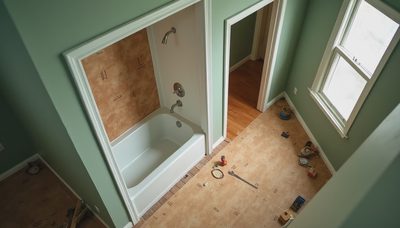
A few years back, I did a bathroom in a 1920s row house in Fishtown. The homeowner wanted to save money, so he'd already demo'd the tile and toilet. When I got there, the subfloor was rotted through in a 2-foot circle around the toilet flange. He'd tried to patch it with a piece of 1/2-inch plywood and construction adhesive. The new toilet wobbled. I cut out the whole quadrant, sistered two joists (the leak had rotted the ends), and laid new 3/4-inch plywood. Total cost to replace subflooring in that bathroom: $850, including the sistering. The homeowner had already spent $150 on his patch that didn't work. Don't be that guy.
Bottom Line
If you're just swapping out a small section of subfloor, you might get away for $400–$600. But if the job requires opening up the floor, addressing rot in the joists, and reinstalling a toilet or shower base, budget $800–$1,200. And don't forget the finishing costs: new underlayment, flooring, and sealing.
Here's my rule of thumb: take the square footage, multiply by $15, and that's your worst-case scenario for a complete subfloor replacement to finished floor. For a standard bathroom, that's $600–$1,200. Get three quotes, ask for references, and don't let anyone talk you into a cheap patch that'll fail in two years.
A bathroom built right once is a bathroom you forget about. That's the point.
How to Know If Your Subfloor Needs Replacing
You don't need to wait for a soggy spot. A few simple checks can tell you whether the cost to replace subflooring is in your future or if you can get by with a patch.
- The bounce test: Stand in the middle of the room and jump lightly. If the floor flexes more than a quarter-inch, the subfloor is probably rotted or undersized.
- The moisture scan: A moisture meter (about $30 at the home center) reads 15% or higher on a plywood subfloor? That's trouble. Anything above 20% means rot is already happening.
- The screwdriver test: Push a flathead screwdriver into the floor near the toilet flange or shower drain. If it sinks in more than an eighth of an inch like butter, the subfloor is gone.
- The smell: A musty, damp smell that never goes away, even after cleaning, often means mold deep in the subfloor.
- Yellow or black stains around plumbing fixtures: Those are not cosmetic. Water has been seeping for months.
If any of these apply to you, planning for the cost to replace subflooring now will save you from a bigger headache later. Ignoring it is how a $500 fix becomes a $2,000 floor replacement plus a new toilet and tile.
FAQ: Will Homeowners Insurance Cover Subfloor Replacement?
This is a common question. Standard homeowners insurance covers sudden and accidental damage — a burst pipe, a leaking dishwasher that flooded the kitchen. It does not cover long-term leaks, rot, or lack of maintenance. If your subfloor rot is from a hidden leak that you didn't know about, some policies might cover it, but only if you can prove the damage was sudden. Usually, insurers deny claims for gradual damage. Plan to pay out of pocket for the cost to replace subflooring unless you have documented recent water damage from a specific event.

No notes yet — be the first to inscribe one.