
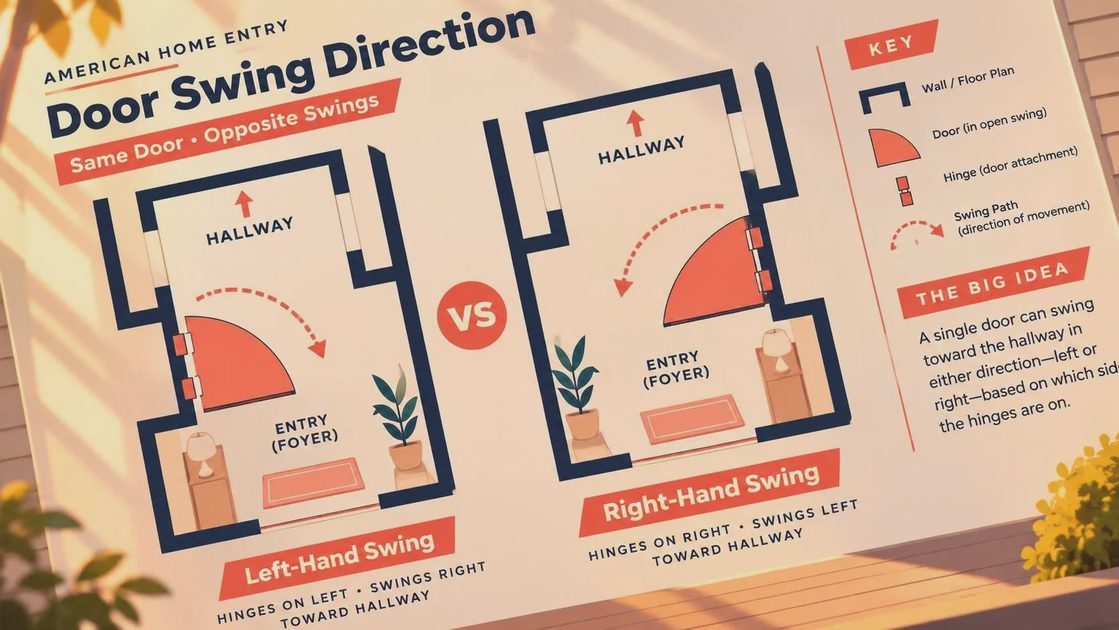
The quickest way to settle a left vs right hand door question is to identify the hinge side and the direction the door swings, then compare both with the seller’s diagram. For a common interior-door convention, stand with your back against the hinges: if the door is on your left, it’s left-hand; if it’s on your right, it’s right-hand. But manufacturers and retailers don’t always label doors the same way, and shower doors can follow their own diagrams. Never order on the name alone.
Start with the hinges, not the knob
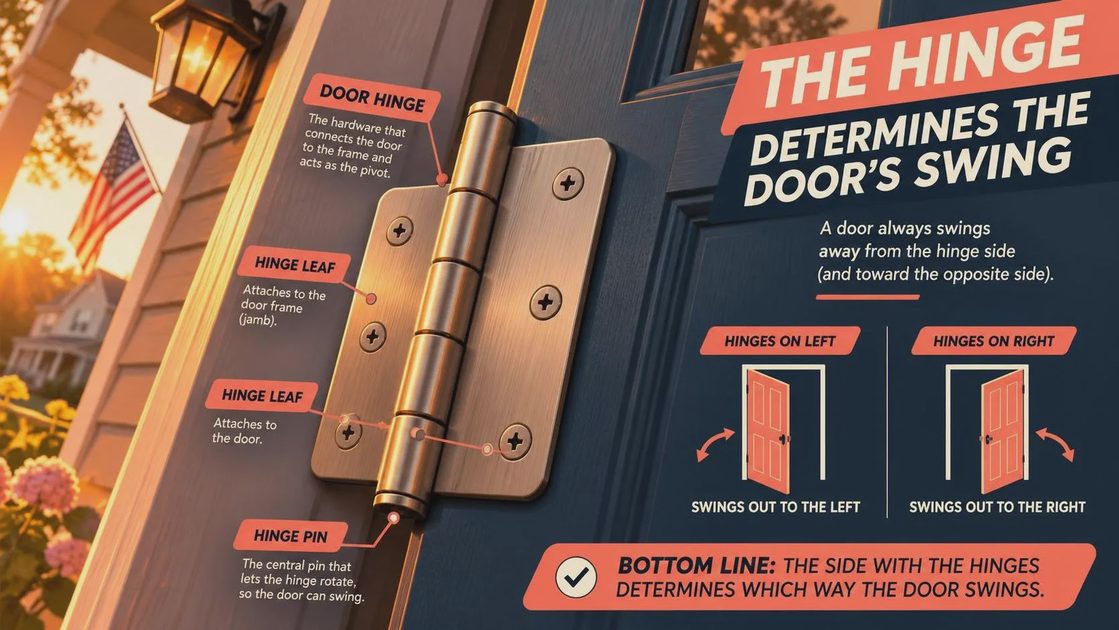
Open the door and put your back against the hinge jamb, the vertical side of the frame where the hinges attach. Picture the door leaf closed across the opening. If it extends to your left, that’s commonly called a left-hand door. If it extends to your right, that’s commonly called a right-hand door.
Here’s a check using a closed door: stand on the side where you can see the hinge knuckles. Under that same convention, hinges on your left mean left-hand; hinges on your right mean right-hand. This view also tells you which way the door swings: it opens toward the side where the hinge knuckles are visible.
That hinge-side view is useful, but don’t confuse it with the view from outside a room. A bathroom door may swing into the bathroom or out into the hall. Your position relative to the hinges, not whether you’re standing in the hallway, is what matters for this check.
Before you buy, write down two separate facts: hinge side as viewed from a specified side of the opening, and whether the door opens into or out of the room. A quick sketch beats an argument at the pickup counter.
Why left vs right hand door labels cause trouble
Some sellers use a different reference point, especially for exterior doors and doors described as reverse swing. Terms such as left-hand reverse can mean different things depending on the supplier’s system. A label that sounds definitive can still leave you with hinges on the wrong side or a slab that swings the wrong way.
For example, suppose you’re standing in the hall looking at a bathroom door. The hinges are on your left, and the door opens toward you into the hall. Tell the supplier exactly that. Then ask them to point to the matching picture in their ordering guide. Don’t just say “left-hand” and hope you’re both imagining the same view.
A prehung door includes a slab mounted in a frame, so handing affects the frame and hinge locations as well as the swing. With a replacement slab, existing hinge and latch positions matter too. Measure and check those details before assuming a door labeled with the right hand will drop into an old frame.
If you’re ordering online, save the product’s handing diagram with your order confirmation. It gives you something concrete to compare against the delivered door before anyone cuts or installs it.
Shower doors need their own check
A shower door is where I get especially wary of handing labels. Hinged, pivoting, and sliding enclosures don’t all use the same language, and a manufacturer may describe the hinge or handle position from a particular viewing side. Some doors are reversible; others are not. Look at the installation instructions for the exact model before ordering.
For a hinged or pivoting shower door, stand outside the shower and note which wall will carry the hinge or pivot. Then check the manufacturer’s diagram for that outside view. Also check whether the door can swing outward without hitting the toilet, vanity, towel bar, or bathroom entry door.
Glass shower doors generally need an outward-opening path for safety; check local requirements and the manufacturer’s instructions for the enclosure you’re installing. Don’t assume a door that swings inward only will be acceptable. A qualified installer or local building department can help confirm the requirements for your setup.
Sliding doors are different. There may be no hinged swing to identify, but the arrangement of the fixed and moving panels still matters. Check where you’ll enter, where the showerhead sprays, and which panel the manufacturer expects nearest the water. A reversible listing does not automatically mean every panel arrangement is recommended.
Measure the space before committing
A door can have the correct hand and still make a bathroom miserable. Swing it into a vanity and you’ll be patching the wall before the grout has had a chance to get dirty. Lay out the full arc on the floor with a tape measure, using the door width as the approximate radius from the hinge. Check it with drawers open and with a person standing at the sink.
For a shower enclosure, measure the finished opening after wallboard, waterproofing, tile, and trim are in place, or have the glass installer measure it. Take width measurements at the top, middle, and bottom, and check the walls for plumb. A custom glass shop needs the actual finished dimensions, not the rough framing dimension from a drawing.
Also identify what’s behind the hinge-side wall. Heavy glass needs the support specified by the door manufacturer; tile and drywall alone are not a substitute for proper structural backing. Sort that out before the walls are closed. Drilling into finished tile to discover there’s nothing solid behind it is an expensive way to learn.
What to tell the supplier or installer
Send a photo from each side of an existing doorway, with the door partly open. Add arrows showing the hinge side and intended swing, and label which side is the hall, bathroom, or shower. For a new opening, a simple plan-view sketch with the same labels works. Include the measured opening and whether the floor and walls are finished.
Ask the seller to confirm the hand using that sketch and the specific product’s diagram. For an old frame that isn’t square, or a shower opening with noticeably uneven walls, have the installer verify measurements before the order goes in. The few minutes spent confirming the swing are cheaper than paying for a door that can’t be returned.
Bottom line: describe the hinge side and swing in plain English, then match them to the manufacturer’s diagram before you pay.



No notes yet — be the first to inscribe one.