There was a row house in Fishtown last spring. The homeowner had already hung a 4 light vanity light fixture from a big-box showroom — brushed nickel, clear glass domes, the kind that looks great on a display wall. He'd drywalled over a mess to make it fit, then asked me to tile around it. I took one look at the shadows it threw across his face and told him we'd be moving it before the tile went up. A 4 light vanity light fixture seems like a simple purchase: four bulbs, one bar, mount it over the mirror. But the details — facing, spread, socket type, mounting height — are what separate a good one from a regret. Here's what I check before I recommend any of them.
What to Look for in a 4 light vanity light fixture
First, measure the width of your vanity before you even start shopping. A four-light bar typically has a mounting spread of 24 to 36 inches between the two end screws. If your vanity is 48 inches wide, a 30-inch fixture looks balanced. If you've got a 30-inch sink in a half bath, the same fixture will hang over the edges and look like a clothesline in a closet.
Second, look at the socket orientation. For the widest, most flattering light, sockets should face down, not out. You want the bulbs pointing at the basin, not at your cheeks. I've replaced half a dozen fixtures where the bulbs pointed sideways, and every one of those bathrooms had harsh shadows under the eyes. That's a cheap design detail that makes a huge difference in how you look every morning.
Third, check the damp-rating. A fixture within three feet of a sink or shower in a bathroom needs at least a damp-rated UL listing. Most big-box fixtures have it, but some decorative fixtures don't, and condensation will get into the sockets and corrode them within a year or two. If the label doesn't say damp or wet, skip it.
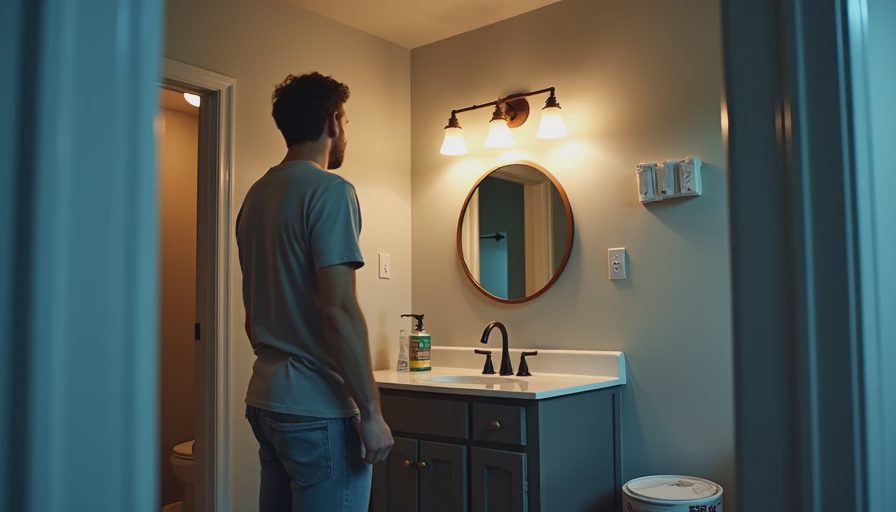
The Brands That Hold Up
Progress Lighting and Kichler are the two names I trust when a homeowner asks me what to buy. Progress Lighting typically lands between $100 and $250 for a solid four-light bar, and Kichler runs $200 to $500. Both use ceramic sockets and a decent powder coat that doesn't flake in a steamy bathroom. Sea Gull Lighting makes a good mid-range option around $150. If the budget is tight, Hampton Bay from Home Depot will do the job, but I'll be honest: the finish will start looking tired after eight or ten years in a damp environment, and the sockets aren't as easy to replace when a bulb breaks off in them.
I steered a couple away from a $49 fixture last month. The housing was plastic, the wire was aluminum, and the whole thing felt like a toy. Fifty bucks is tempting, but the labor to install it costs the same as a quality fixture. You'll be paying an electrician $150 to hang a piece of junk. Spend the extra $80 once and forget about it.
Bulbs: The Part Everyone Gets Wrong
Four bulbs isn't a wattage spec. A lot of fixtures now accept either A19 medium-base bulbs or smaller candelabra-base E12 bulbs. For a 4 light vanity light fixture, I recommend warm LED bulbs around 2700K to 3000K. A 60-watt equivalent per socket is usually enough, giving you roughly 2,400 to 3,200 lumens total for a 5-foot vanity. You don't need 5000K daylight in a bathroom unless you enjoy seeing every pore like you're under a surgeon's lamp.
Match the bulbs to the fixture's maximum wattage printed on the label. I've seen people screw 100-watt incandescents into a fixture rated for 60 and bake the wiring until the insulation cracked. In a small bathroom, four 60-watt equivalents is plenty, and it keeps the heat down in the summer.

Installation: What It Takes and What It Should Cost
Replacing an existing fixture is a two-hour job if the wiring is already roughed in and the box is solid. If you're mounting a new vanity light fixture where nothing was before, expect to pay an electrician $150 to $300 to run a new circuit or extend the wiring, plus the cost of cutting into drywall and patching it after. That's why I always tell people to decide on the fixture before the tile goes up, not after. I've had more than one homeowner hand me a fixture after the drywall was finished, and we had to tear out a perfectly good sheetrock patch to move the electrical box.
Most quality fixtures come with a mounting bar that slides left and right. That bar is your friend. It lets you center the fixture with wiggle room so you don't have to rely on a crooked box. If the bar isn't included, buy one for five bucks rather than forcing the fixture to sit twisted. And never skip the box. Fixtures need to hang on a metal box rated for the weight, not just drywall with plastic anchors. If you feel any give after it's installed, call an electrician before you touch the wire again.
The Bottom Line
Pick a 4 light vanity light fixture from a name brand, face the sockets down, use warm LEDs, and mount it at eye level. You'll get a bathroom that's useful and easy to live in, with no flicker and no shadows. A bathroom built right once is a bathroom you forget about. That's the point.



No notes yet — be the first to inscribe one.